Car Battery Voltage Chart: What Voltage Should Your Battery Show?
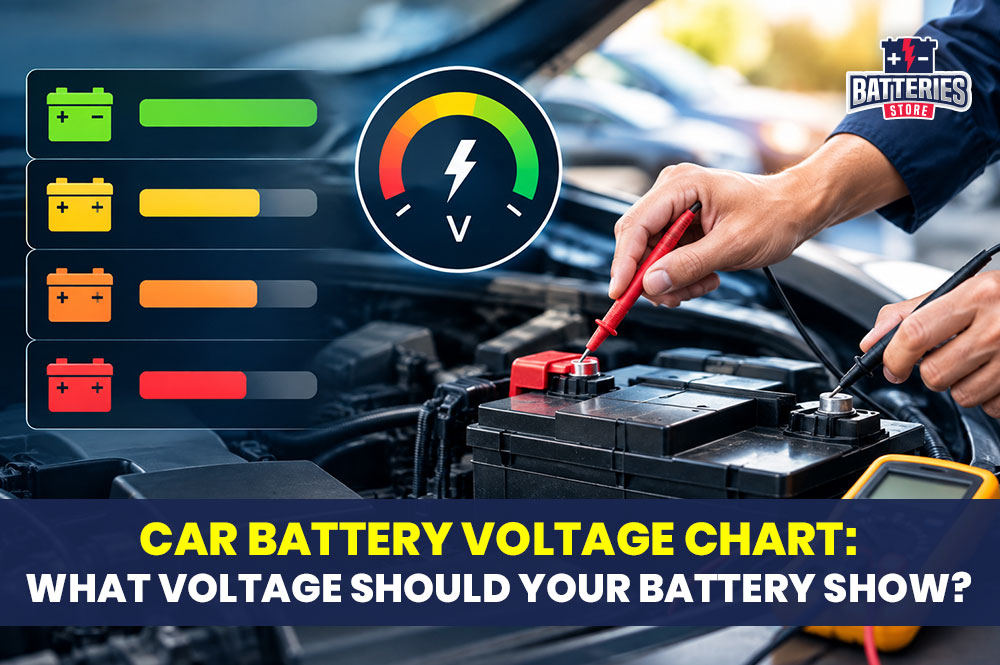
Your car may have a “12V battery,” but a healthy battery usually shows more than exactly 12 volts. A Car Battery Voltage Chart can help you understand whether your battery is charged, partly discharged, or needs further testing.
However, voltage does not tell the whole story. Testing conditions, temperature, battery type, and recent driving can all affect the number on your multimeter.
Car Battery Voltage Chart: Understanding the Numbers
For a conventional 12V lead-acid battery at rest, the following readings provide a useful reference. Exact readings can vary with battery design and temperature.
| Resting Voltage | Approx. State of Charge |
| 12.65V | 100% |
| 12.45V | 75% |
| 12.24V | 50% |
| 12.06V | 25% |
| 11.89V | Essentially discharged |
These numbers describe state of charge, not necessarily battery health. A battery showing 12.6V may still struggle to supply enough current when starting an engine.
Therefore, use the chart as a reference rather than a final diagnosis.
Why Does a 12V Car Battery Read Around 12.6V?
A standard automotive lead-acid battery contains six cells connected in series. That is why it is commonly called a 12V battery.
When fully charged and rested, however, its open-circuit voltage is normally around 12.6V or slightly higher.
So, seeing 12.6V on your multimeter is not overvoltage. It generally indicates a well-charged conventional battery.
Car Battery Voltage Chart: Engine Off vs Running
Testing with the engine off and testing while it runs answer different questions.
With the engine off and the battery rested, voltage mainly helps estimate its state of charge. Once the engine starts, the charging system influences the measurement.
As a result, a higher running voltage can be normal. However, modern smart charging systems can vary their output. Therefore, one fixed running-voltage number should not be applied to every vehicle.
Check your vehicle manufacturer's specifications if the running voltage appears unusual.
Why Resting Time Matters Before Testing
Imagine checking your battery immediately after a highway drive. Your multimeter shows a strong reading, so you assume everything is fine.
That reading may include surface charge from recent charging.
For a more meaningful open-circuit reading, allow the battery to rest before testing. Recent charging or discharging can temporarily distort voltage-based state-of-charge estimates.
Is 12.4V, 12.2V or 12.0V Bad?
Context matters.
A rested conventional battery around 12.4V is partly discharged. Around 12.2V indicates a substantially lower state of charge. A reading near 12.0V means the battery is deeply discharged according to common lead-acid reference values.
However, a low reading does not automatically mean the battery needs replacement.
The battery may simply need charging. On the other hand, a battery that repeatedly loses charge could indicate an ageing battery, parasitic drain, charging problem, or another electrical issue.
Therefore, investigate the cause rather than replacing the battery based on one measurement.
Why Normal Voltage Does Not Always Mean a Healthy Battery
This is one of the most important points to understand.
Voltage shows electrical potential. It does not directly tell you how much usable capacity or starting performance remains.
For example, an ageing battery could show an acceptable resting voltage. Yet when the starter demands high current, the battery may fail to perform properly.
That is why a proper battery test can be more informative than checking voltage alone.
If your vehicle cranks slowly despite a reasonable resting voltage, further battery testing makes sense.
Temperature Can Affect Your Car Battery Voltage Reading
Canadian weather adds another variable.
Temperature affects battery behaviour and open-circuit voltage. Therefore, readings taken during a warm afternoon may differ from readings taken in freezing conditions.
Avoid comparing two readings without considering when and how they were measured.
Cold conditions also increase the importance of adequate starting performance. For Canadian drivers, both voltage and the battery's specified Cold Cranking Amps deserve attention.
AGM Battery Voltage vs Flooded Battery Voltage
Not every automotive battery behaves identically.
AGM and conventional flooded lead-acid batteries use different internal designs. Their voltage characteristics and charging requirements can differ slightly.
Therefore, always interpret voltage according to the battery technology and manufacturer's specifications.
This becomes particularly important with modern vehicles using start-stop systems or advanced charging management.
How to Check Car Battery Voltage With a Multimeter
Park safely and switch off the engine and electrical accessories. Let the battery rest before taking an open-circuit measurement.
Set your multimeter to DC voltage. Connect the red probe to the positive terminal and the black probe to the negative terminal.
Read the display and compare the result with the appropriate specifications for your battery.
Avoid allowing tools or probes to bridge the battery terminals.
When Should You Get Your Car Battery Tested?
Consider a proper battery test if your vehicle cranks slowly, repeatedly needs a boost, loses charge, or produces inconsistent voltage readings.
Also investigate if a charged battery quickly returns to a low state of charge.
Remember, a voltage test answers “How charged does this battery appear?” It does not always answer “How healthy is this battery?”
Also Read: Ultimate Guide to Choosing the Right Car Battery
Know What Your Car Battery Voltage Is Really Telling You
A Car Battery Voltage Chart is a useful starting point for understanding your battery. Around 12.6V generally indicates a well-charged, rested conventional 12V lead-acid battery. Lower readings indicate progressively lower charge levels.
Still, do not judge a battery by voltage alone. Consider battery type, temperature, starting performance, charging behaviour, and vehicle specifications.
When in doubt, proper battery testing can help determine whether you need a recharge, further diagnosis, or a replacement battery.
Read Also: How Long Does a Car Battery Last in Canada