What Does Battery Group Size Mean? Complete Guide
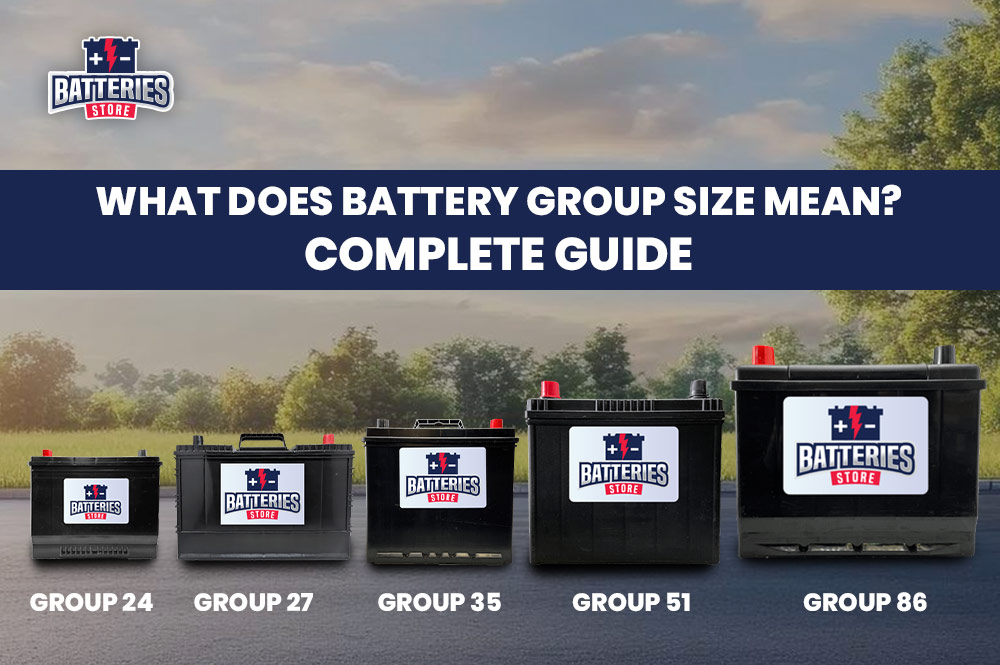
If you have ever walked into a battery store and stared blankly at rows of batteries wondering which one fits your car, boat, or RV, you are not alone. One of the most confusing aspects of buying a battery is understanding what the group size means and why it matters. Whether you are searching for a car battery group size chart, a marine battery group size chart, or a 12V battery group size chart, this complete guide will walk you through everything you need to know.
At Batteries Store, we help customers find the right battery every single day. This guide is designed to take the guesswork out of the process so you can shop with confidence, extend your battery life, and keep your vehicle or equipment running at its best.
What Is Battery Group Size?
Battery group size is a standardized code assigned by the Battery Council International (BCI) that defines the physical dimensions of a battery - specifically its length, width, and height - along with the placement of its terminals (positive and negative posts). It is not a measurement of power output, voltage, or brand. It is purely a sizing and fitment standard.
Think of battery group size the way you think of shoe size. A size 10 shoe does not tell you how comfortable it is, what colour it comes in, or how long it will last - it simply tells you the shape and fit. Similarly, a battery group size like Group 24, Group 35, or Group 65 tells you the physical box dimensions and terminal layout, ensuring the battery will physically fit into the battery tray of your vehicle and that the cables will reach the correct terminals.
Group sizes are typically expressed as a two-digit number (e.g., 24, 35, 51, 65, 75, 78) or a number-letter combination (e.g., 24F, 34R, 51R). The letter suffix indicates terminal placement - for example, "F" means the positive terminal is on the right side when facing the battery, while "R" indicates it is reversed.
Why Does Battery Group Size Matter?
Choosing the wrong battery group size can lead to a surprising range of problems. Here is why getting the right group size is so important:
Physical Fit: A battery that is too large will not fit in the battery tray or under the hood. A battery that is too small may shift around during driving, causing vibration damage to both the battery and the vehicle.
Terminal Placement: If the positive and negative terminals are in the wrong positions, the cables may not reach or may be forced into unnatural positions, creating short-circuit risks.
Secure Mounting: Batteries are held in place with hold-down brackets. An incorrectly sized battery may not be properly secured, leading to vibration damage and potentially dangerous battery acid spills.
Electrical Compatibility: The battery must fit within the vehicle's battery management and charging system. Installing the wrong group size can affect the electrical system's ability to maintain a proper charge.
In short, the battery group size is the first filter you should apply when shopping for any replacement battery - before you even look at Cold Cranking Amps (CCA), Reserve Capacity (RC), or brand.
How Is Battery Group Size Determined?
Battery group sizes are established and maintained by the Battery Council International (BCI), a North American trade organization. BCI publishes a standardized chart that assigns a group number to every combination of battery dimensions and terminal configuration they have recognized.
Manufacturers follow this standard so that consumers, mechanics, and retailers can communicate clearly about battery fitment without needing to measure every battery by hand. When a vehicle manufacturer designs a battery tray for a car or truck, they engineer it to accept specific BCI group sizes. The owner's manual then lists which group size or sizes are acceptable for that vehicle.
It is worth noting that multiple battery group sizes may be compatible with the same vehicle in some cases, particularly in trucks and SUVs where the engine bay is large enough to accommodate slight size variations. However, you should always check your owner's manual or consult a battery specialist before substituting a different group size.
How to Read a Battery Group Size Chart
A battery group size chart is a reference table that lists BCI group numbers alongside the corresponding physical dimensions (length, width, height) and terminal positions. Learning how to read one is straightforward once you understand the columns.
Here is what each column in a standard battery group size chart represents:
- Group Number: The BCI-assigned identifier (e.g., 24, 35, 65, 78).
- Length (inches or mm): The longest side of the battery case.
- Width (inches or mm): The shorter horizontal dimension.
- Height (inches or mm): Measured from the base to the top of the battery case (not including terminal posts, which add extra height).
- Terminal Layout: Indicates the position and polarity of the terminals (e.g., positive terminal on the left or right, top-post or side-post).
When using a battery group size chart, find your vehicle's recommended group number first, then compare the dimensions to the space available in your engine bay or battery compartment. If two group sizes are physically similar, always confirm terminal placement before purchasing.
Car Battery Group Size Chart: Find the Right Fit for Your Vehicle
The car battery group size chart below covers the most common group sizes used in passenger vehicles, trucks, minivans, and crossover SUVs in Canada. This reference covers typical North American vehicles but always verify with your owner's manual or a professional at Batteries Store.
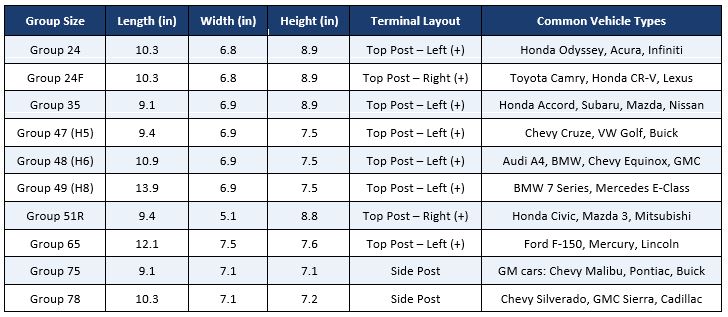
Note: Terminal placement can vary between battery brands even within the same group. Always verify polarity markings before installation. Batteries Store offers free in-store battery testing to ensure proper fitment.
Marine Battery Group Size Chart: Powering Your Boat the Right Way
Marine batteries have their own set of BCI group sizes and are engineered to handle the unique demands of boating - constant vibration from waves, moisture exposure, deep discharge from trolling motors and onboard electronics, and the need for reliable starting power. When consulting a marine battery group size chart, you will encounter both starting batteries and dual-purpose (start/cycle) batteries.
Marine batteries are typically rated in two additional ways beyond group size: Marine Cranking Amps (MCA), which measures starting power at 32°F (0°C), and Amp Hours (Ah), which measures how long a battery can deliver a sustained load. For Canadian boaters, cold-weather performance is particularly important.
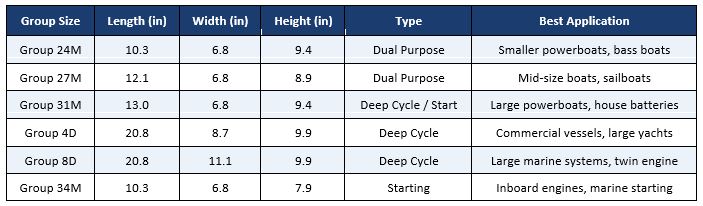
For Canadian boaters operating in cold-water environments like the Great Lakes, Georgian Bay, or along the Atlantic and Pacific coasts, choosing a marine battery with high CCA ratings is essential. Cold temperatures significantly reduce battery capacity and cranking power. Always size up in reserve capacity when boating in Canada.
Deep Cycle Battery Group Size Chart: For RVs, Solar & Off-Grid Use
Deep-cyclebatteries are designed to be discharged repeatedly down to 50 to 80 percent of their capacity and recharged many times over their lifespan. Unlike starting batteries - which deliver a quick burst of energy to start an engine and then recharge immediately - deep cycle batteries provide a steady, sustained flow of energy over long periods.
They are used in a wide range of applications: RV house batteries, off-grid solar storage, electric golf carts, marine house banks, and mobility scooters. The deep cycle battery group size chart below covers the most commonly used group sizes for these applications in Canada.
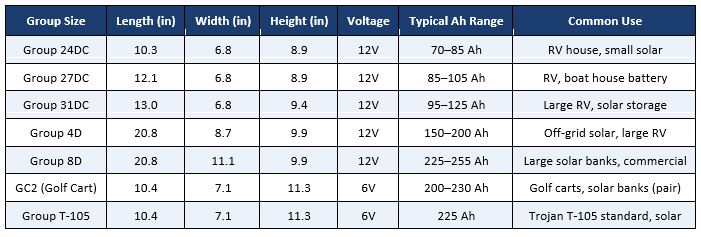
When building a deep cycle battery bank for solar or off-grid use, remember that connecting two 6-volt batteries in series produces a 12-volt system with the same amp-hour capacity as each individual battery, while connecting two 12-volt batteries in parallel doubles the amp-hour capacity while maintaining 12 volts. Proper battery bank configuration is key to maximizing your investment.
RV Battery Group Size Chart: What You Need for Life on the Road
RV batteries serve two distinct purposes that are often confused by new RV owners. The chassis battery (also called the starting battery) starts the motorhome's engine, just like a regular car battery. The house battery (or house bank) powers all of the RV's living amenities: lights, refrigerator, water pump, entertainment systems, furnace fan, and more.
These two battery systems have very different requirements, and using the wrong type in the wrong role is one of the most common - and costly - mistakes RV owners make. The RV battery group size chart below will help you identify what size fits each purpose.
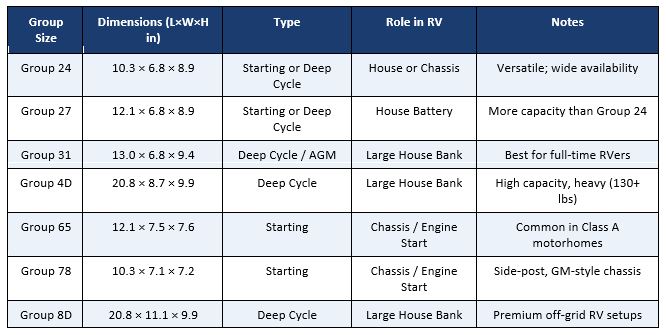
For full-time Canadian RVers who travel through cold winters, AGM (Absorbent Glass Mat) batteries in Group 31 or Group 4D sizes are strongly recommended for house duty. AGM batteries tolerate freezing temperatures far better than flooded lead-acid batteries, charge faster, and require zero maintenance since they are sealed with no liquid to freeze or spill.
Tip: Always run your chassis and house batteries as separate isolated systems with a battery isolator or battery-to-battery charger. This prevents the house battery from draining your starting battery when shore power is disconnected.
12V Battery Group Size Chart: A Universal Reference Guide
The term "12V battery group size chart" is one of the most frequently searched battery-related terms in Canada, and for good reason. The vast majority of vehicles, marine vessels, RVs, and off-grid power systems in Canada run on 12-volt battery systems. Below is a comprehensive 12V battery group size chart that consolidates the most common BCI group sizes with their dimensions and primary applications.
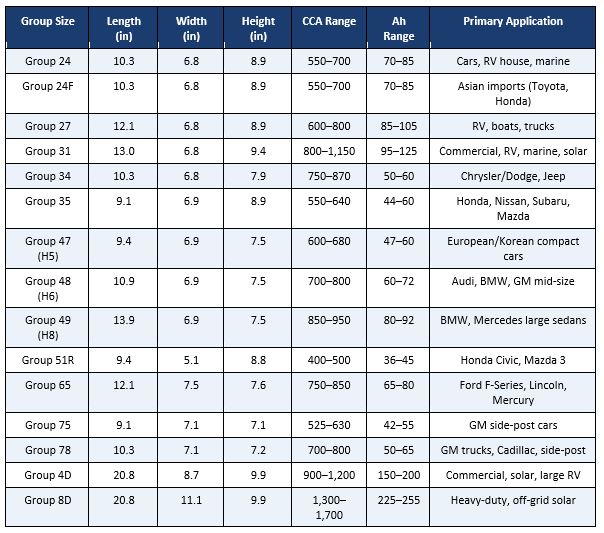
CCA and Ah ratings vary by manufacturer and battery chemistry (flooded, AGM, lithium). The ranges above represent typical values for standard flooded and AGM lead-acid batteries.
Most Common Battery Group Sizes and What They Fit
While the full battery group size chart can seem overwhelming, the reality is that a handful of group sizes cover the vast majority of vehicles on Canadian roads. Here is a closer look at the most popular group sizes and the vehicles they fit:
Group 35 – The Versatile Compact
Group 35 is one of the most widely used batteries in North America. It fits a broad range of Japanese and Korean vehicles. You will find Group 35 batteries in Honda Accord, Nissan Altima, Subaru Outback, Mazda CX-5, Toyota Tacoma (older models), Hyundai Tucson, and Mitsubishi Outlander, among many others. Its compact footprint makes it ideal for smaller engine bays.
Group 48 (H6) – The European Standard
The Group 48 Battery, also called H6 in European sizing, has become the go-to battery for most modern European and many North American vehicles. It powers Audi A4 and A6, BMW 3 and 5 Series, Chevrolet Equinox, GMC Terrain, Buick Envision, and Volkswagen Tiguan. The H6 is increasingly available in AGM format for vehicles equipped with start-stop technology.
Group 65 – The Ford Workhorse
Group 65 is the battery of choice for many Ford vehicles, particularly full-size trucks and SUVs. It fits the Ford F-150 (various years), Ford Expedition, Lincoln Navigator, and older Mercury Grand Marquis. Its wide footprint and high CCA rating make it a robust choice for cold Canadian winters.
Group 31 – The Heavy-Duty All-Rounder
Group 31 is the go-to battery for commercial vehicles, large RVs, boats, and off-grid solar systems. It offers the highest capacity in a format that is still manageable to install and service. Many Canadian diesel truck owners use Group 31 batteries in their twin-battery setups, and RV enthusiasts favour Group 31 AGM batteries for their house banks.
Group 24F – The Asian Import Standard
Group 24F is the reverse-terminal variant of Group 24 and is used extensively in Toyota, Honda, Acura, and Lexus vehicles. The "F" means the positive terminal is positioned differently from a standard Group 24, so do not substitute one for the other without checking terminal placement first.
How to Find Your Battery Group Size Without the Manual
Not everyone has their owner's manual handy. Fortunately, there are several easy ways to identify the correct battery group size for your vehicle or equipment:
Check the Existing Battery: The easiest method. Remove the battery and look for a label on the top or side. Most batteries have the group size printed prominently - often in a box or circle with large numbers.
Look Up Your Vehicle's Year, Make, and Model: Retailers like Batteries Store maintain detailed fitment databases. Provide your vehicle's year, make, model, and engine size to get an instant group size recommendation.
Check the Battery Tray: Some vehicles have the battery group size or specification printed on a sticker on the battery tray or on the battery cover.
Consult the Owner's Manual or Service Manual: The battery specification is typically found under "Specifications" or in the maintenance section.
Use an Online Battery Fitment Tool: Many battery retailer websites offer VIN-based or year-make-model lookup tools that return compatible group sizes instantly.
Can You Use a Different Battery Group Size Than Recommended?
This is one of the most common questions asked by Canadian vehicle owners, and the answer is: sometimes, with caution. There are cases where a slightly different group size is physically compatible with a vehicle's battery tray and wiring. However, before substituting a different group size, you must confirm three things:
1. Physical Dimensions: The replacement battery must fit within the battery tray or compartment without forcing or bending any covers, brackets, or nearby components.
2. Terminal Placement: The positive and negative terminals must be in the correct positions to connect to the vehicle's cables without strain, stretching, or crossing.
3. Hold-Down Compatibility: The battery must be securable with the existing hold-down bracket or clamp. A loose battery is a safety hazard and will fail prematurely due to vibration.
If all three conditions are met, a different group size may work. For example, a Group 27 is physically similar to a Group 24 but longer, and in some large engine bays or RV compartments, this substitution is acceptable. Similarly, in many trucks and commercial vehicles, Group 31 can be substituted for Group 27 if the battery box allows it.
However, you should never install a battery that is smaller than recommended in a way that leaves it unsecured, and you should never force a larger battery into a compartment that does not accommodate it. When in doubt, consult the professionals at Batteries Store, who can verify fitment before you purchase.
Where to Get Your Battery Tested and Replaced in Canada
Knowing your battery's group size is only part of the equation. Even a correctly sized battery can fail if it is old, sulphated, or damaged. Regular battery testing is one of the most important - and most overlooked - aspects of vehicle maintenance, especially in Canada, where cold winters place extreme demands on battery performance.
At Batteries Store, we offer free in-store battery testing. Our technicians use professional-grade conductance testers that provide an instant assessment of your battery's State of Health (SOH), Cold Cranking Amp (CCA) output versus its rated CCA, and whether it is time for a replacement. This test is completely free and takes only a few minutes.
It is important to note that our free battery test is conducted in-store only. We do not offer roadside or on-street testing. If your battery has failed and your vehicle will not start, call a roadside assistance service to bring your vehicle to one of our locations, and we will take care of the rest.
Important: Batteries Store offers free battery testing in-store only. Please bring your vehicle or battery to your nearest Batteries Store location. We do not perform street-side or roadside testing.
Our stores carry a comprehensive range of batteries for every group size and application - from standard flooded lead-acid batteries to premium AGM, EFB (Enhanced Flooded Battery), and lithium iron phosphate (LiFePO4) options. Whether you need a car battery, a marine battery, a deep cycle battery for your RV, or a commercial-grade Group 8D for your solar system, we have you covered.
Battery Group Size vs. Battery Chemistry: What Is the Difference?
A common area of confusion is the relationship between battery group size and battery chemistry. These are two completely separate specifications, and understanding both is key to making the right purchase.
Battery group size tells you the physical dimensions and terminal layout - nothing more. Battery chemistry, on the other hand, determines how the battery stores and releases energy, its maintenance requirements, its performance in extreme temperatures, and its price point.
Within the same group size - say Group 35 - you can find flooded lead-acid batteries, AGM (Absorbent Glass Mat) batteries, EFB batteries, and even lithium iron phosphate batteries. Each chemistry has its own advantages. For example, a Group 35 AGM battery will cost more than a Group 35 flooded battery but will last longer, perform better in cold weather, require no maintenance, and tolerate deep discharge better. A Group 35 lithium battery will cost significantly more but is lighter, charges faster, and lasts far longer.
The takeaway: always confirm group size first to ensure physical compatibility, then choose the battery chemistry that best matches your budget, climate, and usage pattern.
Conclusion
Understanding battery group size is the foundation of every smart battery purchase. Whether you are looking for a car battery group size chart to find the right fit for your sedan, a marine battery group size chart for your boat, a deep cycle battery group size chart for your off-grid solar setup, or an RV battery group size chart for life on the road in Canada, the principles are the same: find the group size that fits your application physically and electrically, then choose the chemistry and rating that matches your performance needs and budget.
The most common mistake Canadian vehicle owners make is walking into a store and buying a battery based on price alone without confirming group size first. The second most common mistake is assuming that because a battery physically fits, it is the right battery. Always verify group size, terminal placement, and hold-down compatibility before purchasing.
At Batteries Store, we are here to make that process easy. Our expert team can identify the right battery for any vehicle, vessel, or system in minutes. And with our free in-store battery testing service, you will always know exactly where your battery stands before it leaves you stranded on a cold Canadian morning.
Visit your nearest Batteries Store location today or explore our full range of batteries at batteriesstore.ca. Bring in your old battery or drive in with your vehicle and let us handle the rest.
Canada Battery Deals and Special Offers
Frequently Asked Questions (FAQs) About Battery Group Size
What happens if I use the wrong battery group size?
Using the wrong battery group size can result in the battery not fitting the tray, cables that cannot reach the terminals, an improperly secured battery that vibrates and fails prematurely, and, in some cases, reversed polarity that can damage sensitive vehicle electronics.
Is a higher group size number always better?
No. Battery group numbers are not a ranking of quality or power. They are simply size categories assigned by the Battery Council International. A Group 78 is not better than a Group 35 - they are simply different physical sizes designed for different vehicles.
Do all batteries with the same group size have the same power?
No. Two batteries of the same group size can have very different Cold Cranking Amps (CCA), Reserve Capacity (RC), and Amp Hour (Ah) ratings depending on the manufacturer, chemistry, and quality tier. Group size only determines the physical dimensions.
Can I use an AGM battery where a flooded battery is recommended?
In most cases, yes - as long as the group size matches. AGM batteries are a direct physical replacement for flooded batteries of the same group size. However, if your vehicle has a smart charging system or battery management system (BMS), make sure it is configured to charge AGM chemistry, as AGM batteries require a slightly different charge profile than flooded batteries.
How often should I replace my car battery in Canada?
In Canada's cold climate, most car batteries last between 3 and 5 years. Harsh winters accelerate battery deterioration significantly. We recommend getting your battery tested every year once it reaches 3 years of age, particularly before the winter season.
What is the difference between a Group 24 and a Group 24F battery?
A Group 24 and Group 24F battery are the same physical size (same length, width, and height). The only difference is terminal placement. In a standard Group 24, the positive terminal is on the left when facing the battery. In a Group 24F, the positive terminal is on the right. Swapping one for the other without checking terminal placement can result in reversed polarity, which can seriously damage your vehicle.
Are marine battery group sizes the same as car battery group sizes?
Many marine group sizes share the same BCI numbering system as car batteries, but marine batteries are built to different internal specifications. A Group 27M marine battery has the same external dimensions as a Group 27 car battery but is built with thicker plates, vibration-resistant construction, and terminals designed to handle marine environments. Do not substitute a car battery in a marine application expecting it to perform the same way.